Proper 23 (B) – Mark 10: 17-31

Today we’re continuing with our series of encounters (and conversations) in the Chapter 10 of Mark. If you remember from last week, we have seen that in this Chapter, people come to Jesus and ask “all the wrong questions”: those questions that seem to be seeking God’s glory, but in reality show what’s on the inquirers’ minds and what’s in their hearts. Mark shows us how those people who talk with Jesus, whether pharisees, strangers of even Jesus’s own disciples, by asking their questions express their own self centered preoccupations (Sex, money and pride!). They seem to be seeking God but in the end, they are only seeking themselves. So in each of these conversations, Jesus has to re-direct the people towards God’s will and towards the core of God’s law. Jesus does so not by answering the questions directly, but he offers tough reminders about what’s more fundamental and, as he does so, he reveals to people their own hardness of heart, their own incapacity to love as God has commanded. What we realize is that all those people asking questions to Jesus aren’t actually asking about God for the purpose of serving God, they are mostly trying to figure what’s in it for them, or what it is that they can get away with.

Now what could make it better (but actually makes it worse) is that all those people aren’t bad people. In a sense, they are really trying – trying to understand what God expects of them, how they can have an okay relationship with God – but of course, as Jesus shows them, the call of the Gospel is more radical than that.

So this week, Jesus meets with a man who seems like a great candidate for discipleship. He has a lot of respect and admiration for Jesus, and is eager to follow him. Mark tells us the man runs up to Jesus and falls on his knees. He calls Jesus “good” and by this manifests his own desire to be good. He has been following the commandments and wants to inherit eternity. And Jesus loves the man, actually. Mark tells us that, as the man confesses his striving to lead a godly, holy life and after life, Jesus “looked at him and loved him” – so much that Jesus wants him to follow him. But then something really sad happens. Although the man is very pious and eager, he won’t be able to renounce his “many possessions” Jesus asks him to sell for the sake of the poor. So it starts well, but it’s a sad story. The man leaves Jesus, sorrowful, realizing his own incapacity to answer the call.

Now this story has raised many questions – and many anxieties – throughout the centuries. It’s about money, of course. Is Jesus really asking us to be so radical and to sell all we have? Isn’t it possible to follow him while still enjoying the fruit of our labor, the comfort and safety of a good house, abundant food, and of course for us, many of the commodities scientific progress and technology have brought? Well, I am not sure I have an answer to this, but I would respond like I did last week when Jesus was addressing the question of divorce with the Pharisees: We cannot take what Jesus has said to one person or to one group of people at a certain time and place and concerning a specific situation, we cannot take this answer and make it a general rule. When Jesus talked about divorce with the Pharisees, he was talking about the sending away of wives who had stopped being pleasing to their husbands. He wasn’t talking about domestic abuse or even mutual consent to terminate a relationship. In our story today, Jesus asks a man to sell his possessions to follow him, but we know he didn’t ask that from all his disciples. The twelve left their home, but Mary, Martha and Lazarus didn’t. Joseph of Arimathea and Nicodemus were considered “comfortable”, and we don’t see Jesus asking them to give it all away.

So what is Jesus doing? To me, there are three possibilities we may want to reflect a bit on today:

– First of all, we can acknowledge that Jesus never asked everybody to give it all away but he certainly didn’t encourage them to keep it all either. Jesus does not always condemn rich people for being rich, but he certainly never praises them and insist on how difficult it is for them to enter the kingdom of God. Throughout the Gospel, there is actually a conflict between “serving God” and “serving money”, and it looks like we often deceive ourselves when we think that money isn’t our Master. A good indicator in the Gospels whether money is our Master or not is found in our ability to share or to manifest hospitality. Martha and Mary were very hospitable, Joseph was generous (he gave his own tomb for Jesus to be buried in). It’s an important test for each one of us. Whether we have a money or not, the question is what is it that we do with it? Rather than “rich” or “poor”, maybe the criteria is more about whether we are “stingy” or “generous”: Do we use our money for our own benefit, for the benefit of our families, or are we aware of the needs of the poor and if so, how do we address them? Maybe we can have a look at our bank statements and see what it says about the way we live…We could also have a look at where our money comes from. Notice that Jesus replaces the commandment “Do not steal” by “Do not defraud”: How do we make our money? How do we invest it?

– Second point we can reflect on and that is related to what we’ve just said: To me, what Jesus is doing in our passage today is that he tries to redirect the man from his own self-centerdness to the care of others, from preoccupation with self back to relationships. Isn’t it interesting that the man asks how he could “inherit” eternal life, as if it was something else he could add to his possessions? By asking him to sell all he has, Jesus redirects the man to where eternal, real and abundant life is to be found. It reminds me of the letter of James we have studied last month, when James asks us to stop wondering if our faith is saving us and rather ask ourselves if our faith is saving anyone! Jesus invites the man to move from religious, legalistic preoccupations that end up being preoccupation with self to a life of self giving and relationships – what Peter reminds Jesus they all did. The problem with money and possessions is that they make “self sufficient” and unable to relate to others. Money will easily make us feel like we don’t need anyone beyond our family and we end up being unable to see anyone’s needs.

– Last observation: I think that in the end what Jesus does is to reveal to the man his own hardness of heart. By asking him to let go of his possessions, he makes the man realize how much he hold on to these things, how much his many possessions are possessing him. Well, maybe the man does not realize it, but the reader of Mark certainly does! Maybe it’s an example for us, a counter example and an invitation to think about what it is for us that gets in the way to start living the eternal, real, abundant life that God has promised us. What is it that we hold on to? It does not have necessarily to be materiel possessions, so we need to do some thinking: Maybe that’s a something we could focus our prayers on this week: What is it that gets in the way? As we do that, unlike the characters of the Gospels who ask “all the wrong questions”, maybe we can start realizing what a good and brave question to ask Jesus could look like!
Proper 22 (B) – Mark 10: 2-16

This week we are finally back in the Gospel, and we will actually stay with the Gospel for four weeks, which is the time it will take for us to cover the whole of Mark’s chapter 10. As I have told you before, I have called this sermon series “Overcoming our hardness of heart”, but really what I thought to myself was that I could have called it “Sex, money and pride” because it really is what it’s about! It’s about all those things that get in the way between us and the loving relationship we could have with God and with one another.

Maybe you have had a chance to read the whole chapter for today, if you have done so you will probably have realized that there is a very clear structure to this chapter: Mark describes four encounters (or four conversations) between Jesus and different people, whether they are Pharisees, complete strangers or the disciples themselves. And what is common to all those encounters (conversations) is that everybody ask Jesus the wrong questions. And what happens is that as they do so, they reveal what’s in their hearts, their own preoccupations with sex, money and glory – and they just want to make sure that’s God on board with it.

Today the Pharisees want to know if it’s okay with God if they divorce their wives when they are bored with them.
Next Sunday, we’ll see how a young man wants to know if it’s okay with God to enjoy his wealth in the meantime he keeps looking for the kingdom.
Then James and John will ask Jesus if it’s okay with God that they will sit at Jesus’ right and left in his glory after Jesus has suffered what he had to suffer
Finally, at the end of our chapter, we will see how Jesus meets a beggar, a blind man who at last seems to understand what following Jesus is about.

So you see there is a unifying theme in this chapter. It’s about sex, money and pride all right, but the commonality is that people seem to be seeking limits. What they can get away with and what won’t be acceptable and could deprive them from eternal life. They are all bargaining with God! And those people are not bad people. They are all following Jesus (even if it’s to test him) and they all take Jesus seriously enough to hear what he has to say on these different matters. But of course we see the common pattern: they try to understand what’s in it for them (like John and James) or how much they can get away with without serious consequence (like the Pharisees and the young man). I think it’s important we notice that because I guess it’s also about each one of us. We all wonder at some point what we can obtain from God and what we can get away with.

What’s more important to notice though is that each time, Jesus will answer people’s questions, yet he does so not by giving them what they would call a satisfying answer, rather Jesus turns the question back at them so they would understand what their questions are really about and what they reveal about their own hearts, their own thoughts. Maybe you know this saying that we “question the Scriptures”, but eventually the Scriptures end up “questioning us”, by the stories they tell they question our lives, our choices our characters…and well, this is exactly what happens here. Jesus is wondering aloud: “Well, what does it tell me about yourself, about your heart, that you would ask me such a thing?”

If you remember from the letter of James (James as in Jesus’s brother, not the James Son of Zebedee we hear about in this chapter) – James asks us to pay attention to our prayer life and he says that we don’t receive from God because we ask for the wrong things. We can see that clearly in Mark 10: People asking for all the wrong things, people asking God to tolerate or even to help them indulge in their thirst for glory, money or sex – and each time Jesus has to bring them back to the fundamental law of love they seem unable to observe or even to understand, even as they all try to be good, religious people.

So this is for the pattern. But back to our text today. Well, this is a tricky one because this passage has been much used by the church to keep people – especially women – in bad marriages, claiming that Jesus has a zero tolerance to divorce, and that divorce is systematically associated with adultery. Well, first of all Jesus does not associate divorce with adultery, that would be re-marriage, and re-marriage only as understood by the Pharisees asking the question on that day: whether it was okay to divorce – literally to “send away” – your spouse in order to find a new one. The Pharisees are actually referring to the Mosaic law (law from Moses) that allowed men to divorce wives who did not “please them” (anymore), which kind of indicates something like acting on a whim, or maybe for no other purpose than because they were bored with their wives without fault of their own. At any rate, it is clear that in this passage the Pharisees does not ask if it’s okay divorce their wives because they were abusive, or even because they had “grown apart” emotionally! It’s really about finding a new wife, and a more pleasing one…

And this is to this that Jesus responds. Basically Jesus says that if they were to divorce in these conditions, yes, they would legally have the paper, the certificate of divorce, but in that regard, it does not make much difference to Jesus to be covered by the law. If you send somebody away with no fault of their own just in order to be with somebody else, it’s still adultery. Maybe you can get away with it in the eyes of society or even within your religious organization, but in the eyes of God it does not make much difference, it still is about your motives and your inability to love deeply. And so Jesus reminds the Pharisees of the fundamental law of love: Oneness – which is what God intended from the beginning of creation. Oneness not only within couples, but with one another. If you remember what we said about Jesus’ farewell discourse in John’s Gospel, the disciples also are invited to be united in spirit in the same way couples are united in the flesh. As a reminder, adultery in the Bible has a much wider meaning than being in bed with somebody you’re not married to. It’s about turning against God, or maybe more simply, it’s about our inability to commitment. In the same way that you can be attracted to beautiful people and want to run away with them, Israel was attracted by other gods, gods that weren’t too demanding, gods giving advantages without asking for transformation. Idolatry in the Bible is about those people who want a god that helps them manipulate reality, who gives them advantages, indulges with them without requiring changes of heart (what James calls wisdom, when he opposes true religion and shallow religion). I guess, that at some point or another, we can all recognize ourselves in this as well…

So where do we go from there? By pointing at the little children as the closest to the Kingdom of God, I don’t think Jesus is saying to people that themselves have lost for ever their purity and their innocence…Or maybe they have, but it does not matter in the end because Jesus is trying to re-direct them to what’s more essential. Not “getting by” with appearances or even religious law, not even having “all the right answers” or, for that matter, “having all the right questions”, what’s important in the end is to find a way back from our hardness of heart, to learn how to love again, as little children do. In this process, maybe actually what we really need is to “un-learn” old ways rather than to check another box on the list of the perfect disciple – but about that, we’ll talk next week…

Proper 21 (B) – James 5: 13-20

Today is our last Sunday with James. One of the things we have learned reading this Epistle is that James puts a strong emphasis on the works of faith. And so, it could come as a surprise that this last paragraph is all about prayer – because of our own tendency to oppose contemplation and action. When we talk about the “works of faith”, we usually believe that it is all about practicing charity and helping people in their concrete circumstances. And there is certainly a lot of that in James! Yet if you remember, we have also noticed how much James insists on the value of our words:
In chapter 3, James has warned us against the dangers of the tongue, how we can hurt others and ourselves by what we say, when we slander or gossip. In Chapter 2, James has warned us against speaking empty words to people in need, or giving words of praise to people we value because of superficial judgment, because of their appearance, and then we ignore those who don’t look so good…But what happens in this last chapter is that we learn that if words can bring some hurt and negative effects, they can also bring some good and be redeeming, and especially in the acts of confession and prayer – which are of course two important practices of the church.

So the question for us today is: How are we to practice confession and prayer so they would bring those positive effects?

– First of all, James reminds us to pray “in all circumstances”, which is an idea that is not foreign to the New Testament. We have to pray whatever our emotional or physical state. James says we need to pray whether “suffering, or sick, or cheerful” – because prayer is never easy.

For example, we generally assume that it’s easier to pray when something is wrong (and we need help and guidance). Yet we know that we can also get stuck in those times of suffering, and despair about not being heard and not receiving God’s help. Sometimes when life throws too much at us, it can be difficult to have a sense of God’s goodness and we can be tempted to stop talking to God. But James tells us to pray anyway.
Then, we could also assume then that it would be easier to pray if everything is well is our life, yet we also know that it can be in those times when we forget about God because we don’t need anything. James asks us to pray, to thank God and to manifest our joy.
Finally, we could also assume that it would be easier to pray when we are sick, because we obviously have to ask God for healing – and sometimes we have no other recourse than to ask God. Yet it can also be difficult to pray in times of physical weakness. When our energy is diminished, we can be tempted to become passive. Again, James asks us to pray.

It’s not only that we need God at all times…I think it’s also because – and it’s a very important thing to notice – that for James, prayer is to be practiced in community. We lift each other up and help each other by praying together. The prayer of the cheerful comfort the afflicted, the prayer of the sick brings compassion to the hearts of those well satisfied with their lives…Contrarily to what we generally assume today, faith is not the possession of one individual, it is also the practice of our community. I am tempted to say that our prayer will be as strong (or as weak) as is the faith of our community. Certainly, you have in mind those passages where Jesus performs miracles because of the faith of friends or parents asking for a favor for their loved ones. We also know that at times Jesus encountered so much opposition that he couldn’t perform any miracle.

– This does not mean that the visible outcome of the prayer is an indicator of our faith (whether communal or personal). To James, prayer always brings positive outcome, but those outcomes are mainly spiritual. When James says that the Lord “will raise up the sick”, it can be a physical healing, but he also talks about the Resurrection of the dead of course. He could also talk about giving everyone the strength to carry on…The power of resurrection can take many forms in our lives. Today we call that “resilience”. And certainly supporting each other as a community help us to build that resilience.

– Yet if we go even deeper in our reading, we will realize that when James talks about healing, he talks about the healing brought by the confession of sins, and the confession of sins as a community. Sickness is not an indicator of personal moral failure, but we cannot ignore that people get sick in many different ways when they are morally hurt or rejected. The most important to James is that we first heal our community spiritually, heal of the hurt that we so often inflict on each other, whether on purpose or not. If you remember from last week, James asked us to pray with truthfulness, coming to God with pure intentions…Well, we have also to be truthful to each other when we pray together, and to acknowledge our wrongs, so we can be a healthy and faithful community. We talked about that last week as well. James says that we get caught in conflicts because we are too self centered. Only self awareness of our motives can heal us. We see today that this self awareness can be brought by our community, by gently correcting each other and working on our misunderstandings. This requires from all great humility and a deep desire to change.

– Yet, I think that overall, James’ main idea in this passage is that we need to enter prayer with hope end even optimism because prayer will certainly bring changes. Remember from Chapter 1 that “God is the giver of all good gifts”. When we pray we all expect good things to happen…yet generally what we expect are physical or material advantages. Without denying God’s providence in our daily lives, according to James the main good thing that prayer provides, if we pray in trust and truth, is that we will be saved from sin, whether it is the sin to wander away from God or the sin of the conflicts in the community. In this, we don’t have to worry whether prayer “works” or not, because prayer will always bring victory and peace. When James takes the example of Elijah who could withhold the rain for years or making it come down from heaven, it’s not because James suppose we can control the weather with our prayers (we wish!). It’s an image to tell us that a sincere prayer has the power to open heavens and pour down blessings, not only on us but also on the world: “[Elijah] prayed and the heaven gave rain and the earth yielded its harvest”. James is asking us to believe that it can be true for any of us because Elijah was a “human being like us” who only “prayed fervently”…and received the blessing.

– This is the conclusion of James’ Epistle…If you remember the main question throughout his letter is “How do we treat each other?” – to me, the answer James gives to that question is not only that we should treat each other with respect and fairness, but in whatever we do, whether caring for each other, supporting each other, or correcting each other, we have to be a blessing – we have to be a sign of God’s love for one another. The works of faith are to make God real to one another, to bring God’s presence to one another.

Proper 20 (B) – James 3:13 – 4:3, 7-8a

This is our second to last Sunday with James’ Epistle and we’re coming to the heart of his letter, the core of his message. We now know that James wants to make sure Christians see the difference between true and false religion, between what is deep and real piety and what is an imitation of faith – whether this imitation happens by intentional affectation or because we delude ourselves with shallow and empty feelings. To make the difference between what’s real or not, James says that the best thing to do is to look in the spiritual mirror, to look at the way we live, concretely and how we treat each other. This is what we do (or don’t do) that will testify about our faith. In our text today, James asks us to “(…) show by [our] good life that [our] works are done with gentleness born of wisdom” and the he goes on to describe what wisdom looks like – and this is on that that I would like to spend a little time with you today.

First of all, James notices that everybody is wise in their own eyes, which is probably a very accurate observation! Most of the time, caught in our own inner reasoning, or just because of our blind spots and prejudices, we assume that “this is the way it is” or “this is the way things work”. We don’t hear often people saying about themselves that they are silly or foolish – unless they have just realized they’ve made a big mistake! We naturally assume we are clever and that we know what’s best…And I don’t think James is criticizing that directly – after all, if we were always convinced that we are stupid and wrong it would be very hard to make any progress in life – but James tells us to be careful. Not just because maybe we are not that clever, but also because wisdom is not about being clever, or at least not in the sense we understand it most of the time.

So what’s the difference? Well, James tells us that being wise is not so much about being intellectually sharp or educated. Rather, according to James, wisdom is “(…) peaceable, gentle, willing to yield, full of mercy and good fruits, without a trace of partiality or hypocrisy” (remember how we talked about partiality before?). And so this is what wisdom is really about: it’s about being humble and gentle. You may remember that I told you at the beginning of this study that we could tell that James was indeed Jesus’s brother, because they have the same character! In Matthew Ch 11, Jesus says of himself that he is “gentle and lowly in heart” – and we see that is the personification of wisdom for James! That, and to resist abuse of power and hypocrisy too – which is what Jesus spent his life doing. Being gentle and lowly does not mean that you have no opinion or that you are a doormat. Often today when we say we seek peace or concord, we mean something like: “Let’s not talk about what could bring conflict”. Yet this is not the way James describes it, or the way Jesus lived his life. Seeking peace is not about avoiding conflicts at all cost, by not talking about what goes wrong, peace is about being able to move beyond conflicts by looking for what’s best for everybody, honoring everybody’s right to be a full person – and as we said last week – honoring in each other the likeness of God.

Now what is the problem with us, that so often we think we are wise when we actually lack true Christian wisdom? Well, for James, it’s actually quite simple. He says that what prevents us from being wise is that we are too self centered. And we can be too self centered in two different ways: Either we are focused on pleasing ourselves (we are too self indulgent, we want more than what we really need) or we are focused on our own ambition (we want to be right, to be admired, to have more power). In both cases, we’re seeking our own advantage instead of everybody’s advantage – and this is why we cannot move beyond conflicts. Again, the problem is not so much that there are conflicts, in the sense of difference of opinions, the problem is that James’ community is caught in never ending conflicts because everybody thinks about themselves first!

So how do we move beyond that? Well, once again, James invites us to self awareness. We first have to get rid of our illusion of wisdom, false wisdom, and accept that we often ask or act out of self interest. Aware of that, we already have gained in humility, which enables us to approach God and ask to be filled with true wisdom. In this, we see again how, even without quoting it, that James is close to the fundamental call of the Gospel, that is to repent and to ask God to change our hearts. There is in James a deep trust that God will answer those who come to God. He says: “Draw near to God and God will draw near to you”. Yet there is a condition: We need to come to God with pure intentions – with a “pure heart” in James’ own words. Approaching God with a pure heart does not mean we have to wait to be perfect or much better people to ask God for anything! It just means that we are to be aware of who we are and be willing to change.

And this is, once again, the difference between true and false religion. James asks: What are our intentions when we draw near to God? Is it to seek our own advantage, or is it out of a desire to change? James says that the problem is that, in prayer: “We ask wrongly, in order to spend what [we] get on pleasures”. So it means that we also have to examine our prayer life. Practicing true religion is not about praying a lot, or showing a lot of piety. It is about approaching God with selfless intentions. It does not mean that we shouldn’t pray for ourselves! We can and should certainly pray for protection and guidance and even help in our daily needs, because that’s what Jesus taught us to do in the Lord’s Prayer! But we should not expect God to serve our selfish interests, especially if they conflict with the needs of others. We need to approach prayer with the desire to serve God rather than thinking that God will serve us – this would be worse than false religion, it would be the perversion of religion. We need to ask God to do God’s will, because that’s what Jesus taught us to do as well (in the Lord’s Prayer too!).

To conclude, I think it is important to notice that for James, wisdom is not a private, intellectual thing, rather, it is a matter of practice and wisdom is to be practiced in community, by seeking to move beyond conflicts towards what’s the best interest of all and beyond that, what is God’s will. Wisdom is built in our relationships with others and as we seek a deeper relationship with God. We grow, little by little with one another in our daily circumstances and by being open to God. This is, at least, to James, what a true Christian community should look like.

Proper 19 (B) – James 3: 1-12

We’re continuing this week to read from James’ letter. We now know that James is writing his letter to help Christians understand what true religion is about. James opposes true religion to a “shallow” or “empty” religion. We have seen that to James, true religion is not just a matter of beliefs, or rites, but true faith is the practice of our belief. Faith is revealed in what we do, in the way we behave – and mostly in the way we treat each other in our daily lives. This is what James calls the “mirror”, the “spiritual mirror”: if we look in the spiritual mirror, that is the concrete ways we act towards each other, then we will know what our faith is really about.

In this sense, we talked last week extensively about how James is warning Christians about not showing favoritism. Quite the opposite, James encourages us to treat rich and poor alike, because all men and women are equal in the eyes of God. And so not only Christians aren’t to show partiality but if they ever are to take sides, they should actually be on the side of the poor, as God is, as a way to re-balance power that is always in the hands of the most wealthy in human societies.

It is interesting at this point to notice that, although James’ tone could be described as “moralistic” (We have seen that James is not interested in in-depth theology or details about worship) James is not a moralist either – at least not in the classical sense of the term. James’ letter is not a treatise on virtue, James is not interested in making Christians “good people”, in the sense of “reasonable” or even “virtuous” people. James is not interested in building personal respectability, if you will, rather he is interested in the dynamics or our interactions. What James wants for Christians is that they may be able to act towards each other with respect and fairness.

What is worth paying attention to though, is that in James’ thinking, “the way we act” is not limited to our tangible actions – this week, as we move in the third Chapter of the letter, James asks us to pay attention first to the way we speak. And again, it’s not about us showing ourselves educated or even polite as we speak, but it’s about the way we treat each others when we use words. James is not so much interested in our choice of words, rather what he wants us to be aware of is what our words accomplish. Again, we are drawn from the surface to a much deeper understanding of what true Christianity is truly about: lifting up each other and all people and beholding in them the likeness of God.

At this point I realize I could write pages on gossip (or speak for hours about it) – but I don’t think you would want that or that it’s even necessary. I guess that we have all gossiped and we have all been on the other end of gossip. And we know what gossip does to us – James compares it to a “fire”. It’s impossible to control, it burns, and it destroys relationships. When we gossip, we don’t even know what we are saying! If you have ever been overheard by somebody you were gossiping about, you may know what I am saying: It feels terrible and the first thing you want to tell them is that you didn’t mean it, because indeed you were just rambling, and not thinking! If you have ever heard people talking being your back, you also know the kind of special pain it is. Rejection and judgment can bring deep feelings of shame, self loathing and despair. Not only does it destroys relationships, sometimes it even destroys people themselves. And of course, it’s not only about gossip – I guess we also all carry in our hearts harsh words that have been spoken to us, maybe by a tough teacher or by the bully at school, or even words from a sibling or a friend, and it does not matter if it was 40 or 50 years ago – it still hurts. Or maybe we still regret having said something terrible to somebody! Deep down, we know that words aren’t just words, they are are actions too, would it be only because they can hurt as much as a slap in the face.

There is a very strange passage in the book “The human search of meaning” by Viktor Frankl. As you may know, Frankl spent several years in concentration camps. But he says at some point that what was the worst to him wasn’t the hunger, the nakedness, the freezing, the harsh work and the constant fear of death, he says that the worst thing was the way the nazis talked to them, like they weren’t human beings, like they didn’t really exist.

Words have power and I think what James is asking us to realize is how we often underestimate this power. We think that words don’t matter – when they really do. We can use our words to promote the likeness of God in people, we can also use them to deny their humanity. Blasphemy isn’t about saying a profanity when you drop something on the floor! (and we are so obsessed with “language”, aren’t we?) but if we open the Scriptures, we may understand that blasphemy is really about denying the likeness of God in our neighbors.

I told you several time that James was a very practical and down to earth person. And I think we really can see that in this passage. The spiritual mirror is very close to us. James is not asking us to become very respectable or virtuous people and James is not asking us either to take heroic actions for our faith or to make a big fuss about the charity we practice. At least for today, James is asking us to be mindful of the words we utter every day, in our daily circumstances and how we treat each other as we speak – whether we speak to someone or whether we speak about someone. Not only because it will end up impacting them, but it will also impact ourselves. If we use poisonous words, they will end up poisoning our own hearts.

So what are we to do?

Well, what is surprising is that James concludes that it is almost impossible to do, it’s impossible to “tame the tongue”! James seems to think that there is no remedy! So maybe it’s a call to silence. Which is not always that bad. We saw that in the first chapter, James asks that “everybody should be slow to speak and quick to listen”. Being able to keep silence and to listen is certainly the beginning of wisdom. Yet, and maybe more specifically in our passage, it’s also about awareness: Awareness of the impact of our words. And it can be spoken words but also written words. Maybe we can ask ourselves from time to time: Will I be happy to have written this email or this comment on Facebook in three weeks or three days or even three hours? What good are my words supposed to accomplish in that very situation?

Yet above all of that, what I also hear in James’ letter is that if our words are powerful. In what seems a very practical matter, we have a glimpse of a profound theology: Throughout the Bible, we see that the word of God has the power to create, to bless and to curse – God’s word is action, God’s word moves the world and in Jesus, God’s word came into the world. Our words are powerful too. If words are divine they can create, build up or tear down. James call us to use our words rightly. It does not have a lot to do with niceties – you know like paying everybody a little compliment when you arrive at work. If we were to do that, or to do that only, it would still be taking the surface – being merely polite – for the depths – honoring each other. Rather, it’s a call to be respectful, to encourage, to comfort and it’s also a call to say the truth – not using our words to deceive, manipulate others or just to bring them to like us. This passage is really about power, as power was the center of our previous passage when James asks Christians not to show partiality to the wealthy. In the same way here, James asks teachers to be very careful about their own authority. It’s not only about people whose job is to teach or preach, but for all when we are given authority when we speak. What do we do when we speak? Do we try to assert our own power, or do we try to share the power, do we try to promote our own agenda or do we offer tools to try to seek God’s will together?

If we really believe in the word made flesh, our words should be in the likeness of the God revealed in Jesus Christ: words meant to create, to redeem at our own level. Our words should be life giving. And so maybe to know better how to use our words, we can look at the way James speaks to his people: We do not have to do brilliant philosophy or theology – and it’s quite clear that James does not spend a lot of time philosophizing! It’s about showing love and affirming each other as we speak. It’s not about “walking on egg shells” – most of the time, when we “walk on egg shells” we do that to preserve ourselves, not those we talk to. Loving words often requires simplicity and brevity and directness. Sometimes it’s about having the courage to start a much needed conversation, instead of rambling. And maybe then we can see the changes starting to happen for the best. Remember, for James, true religion is also all about change – changing our hearts and the world around us. Certainly our words can do a lot when we mean what we say.

Proper 18 (B) – James 2: 1-18

We’re back in the letter of James that we started reading last week. If you remember from last Sunday, we discovered in Chapter 1 James’ intentions in writing this letter to his congregation. One of the things we saw is that James is not preoccupied in doing in-depths theology, neither he is preoccupied with regulating the life of the church, whether in its administration or in its liturgy. What James claims to be concerned about is that the followers of Christ would practice true religion – that he opposes to a shallow religion. And to James, practicing the true religion is not necessarily about having all the correct beliefs or doing worship in a way or another. According to James “true religion”, the religion that really connects us to the heart of the faith of Christ, is about obeying the law of love, it’s about loving each other. This love, though, isn’t about tender emotions… James isn’t a dreamer or even a romantic, James is a very practical, down to earth person and he asks the followers of Christ to love each other and every person in the concrete circumstances of everyday life. To James, love is not so much about the feelings we have, rather it is about the way we treat each other.

So how are we to treat each other? Well, James being this very practical, down to earth person, gives us in our reading this week a vivid example of a “real life situation” (actually a lot of commentators have found this example so vivid and true to life that they notice it can make it difficult to hear). James takes the example of the congregation gathered in the synagogue – which would be the place where first Christians came to worship but also to deal with some legal issues (and it is not clear from James’ example if we are in the context of worship or litigation). Yet the context does not matter because it’s really about the way believers behave and interact with one another. And so this is what James says: Two persons show up in the assembly, and because one looks wealthy and nice (“wearing gold rings and fine clothes”), they are well received and given the seat of honor, and because one looks poor and dirty, they are left standing or made sit on the ground. I think we would all agree that this is unfortunate and that this kind of behavior should not happen among Christians…Yet to James, this is much more than an unfortunate situation, rather this should be a serious concern for all of us. James says that in doing so, when believers show partiality or favoritism, they dishonor the poor and they transgress God’s law. James goes even as far as saying that, when we show partiality, we transgress God’s law in the same way that if we’d commit murder or adultery.

That’s of course difficult to hear! And we may feel a bit sorry for these believers James is talking about! Maybe because we can easily identify with them…Who among us never judge people based on their appearances, even unconsciously? And so we think maybe those believers giving the best seat just wanted to be polite or helpful to the beautiful people, and on the other way around, maybe those believers asking the poor to stand were just distracted, or maybe they were a bit scared of them! It may feel a bit unfair to us that they end up being accused by James of a deadly sin…But to really understand James’ intentions with this example, maybe we should resist the temptation to be defensive and ask ourselves: What is at stake in here exactly?

Well, the thing we need to notice is that, in James’ example, the poor and the rich show up in the assembly at the same time. And to me, what James criticizes it’s not so much that we give a good seat to the wealthy and good looking person. He is not asking us to ignore them instead, or to not be too welcoming. And I don’t think James is overly concerned with the fact that some people need to stand in the congregation or sit on the floor when there is no room left. What James is concerned about is favoritism and the injustices they create. It’s because the believers have given the seat of honor to the wealthy that the poor has to remain standing or to sit on the floor. Because they have honored the powerful, the powerless is humiliated. The dignity they have given to one has been taken away from another, and that is what’s wrong with this behavior. So James isn’t asking believers to be unpleasant with people who look good or with people who have money, but he is asking believers to be as pleasant and accommodating with the poor and powerless as they are with people more fortunate, and not make a difference between them, because God does not make differences between people – and when God does make a difference, God would choose the little one over the great (as, for example, God chose Joseph or David against their elderly brothers). This is indeed God’s justice: God empowers the powerless and strip of their power the powerful, and this what the law of Moses and the Gospel of Christ is all about…

And so, in this chapter and beyond this specific example, James asks us to conform the way we behave to the beliefs we profess. True faith is not about having a correct set of beliefs. True faith is about practicing what we say we believe in. James is not teaching his congregation to be mean to rich people, he is teaching them to be fair to everyone and to pay a special attention to those to whom they normally wouldn’t pay attention to. As Christians, we shouldn’t behave according to our “natural tendencies”- according to James, acting like that is the way of the world that is always fascinated by the bright and shiny. Because we admire them or because we fear them or because we expect to receive something from them, we have a tendency to treat better the powerful and the beautiful. Because we are not attracted to them or because they have no power over us or maybe because we just don’t see them, we neglect the poor – but if we truly believe that we are all children of God, then we shouldn’t treat people based on how they make us feel or based on what we expect they would do for us. Moreover, each time we confirm the riches’ privilege we perpetuate the cycle of oppression human societies live by, when our Christian responsibility would be to break the cycle (James asks: “Isn’t it the rich who oppress you? Is it not they who drag you into court?). This goes beyond what happens in our own faith congregations…in reality, it asks us: what kind of society is it that we do want to live in?

So no, it’s not easy to treat all people as equal and we have to work on ourselves to get there, yet this is what true religion requires of us: It requires that we won’t stay on the surface with what we profess. It is to believe with all our being. James wants to show us that it does not matter if we agree with Christian beliefs just because it’s a beautiful thing to believe in – what we have to do is to practice this belief. We can all agree that it is a beautiful thing to believe in justice and equality for all but if we’d truly believe in the beauty of justice then we have to practice it. What would you think of someone who would tell you that ecology is important to them, but then you see that they don’t even bother to recycle their trash? Well, you would probably think, and rightly so, that it’s probably because ecology isn’t that important to them! They don’t really believe in it! James says, well, it’s like when we say to a person who is naked and hungry to stay warm and have a good meal and then do nothing about it. If we really wanted them to stay warm and have a good meal, then we should give them clothes and something to eat, if it’s in the range of our actual possibilities!

James is not criticizing people for saying nice words, or wanting to be polite or comforting, James is warning us, he tells us to beware not to stay on the surface of things. Christianity is not wishful thinking, it is love in action or as the proverb goes, it’s about putting our money where our mouth is! Our faith should change us and change the way we live, change the world starting with the little world we all have around us.

I love it that James asks us if that kind of “faith” (to profess but then not doing anything) can save us. Because we always talk about “the faith that saves” right? Yet when we do that, we always refer to the faith that saves us, personally. But James isn’t asking us if our faith is saving us personally, I think James is asking us if our faith is saving others! And when James is asking us if our faith is saving others, he does not mean if our faith provides a good example to others…James is asking us if our faith is of any good to those around us, and especially to those in need!

Is our faith saving anyone? Is our faith of any good to those around us or in the midst of us? Is our faith accomplishing anything? “Faith, by itself, if it has no works, is dead”. Indeed.

Yes, those words are hard words to hear – But as we mentioned last week, James is asking us to have a look in the spiritual mirror, this mirror being our everyday life, James is asking us to become more self aware and consider our unexamined prejudices, our unexamined behavior and all the things we say are important but we just don’t do. And it’s difficult. Yet we need to remember that James is not trying to put his people down when he calls them out on their behavior. James is trying to lift them up and to make them whole. So they can really be one with themselves, so they can be, so they can incarnate, what they believe in with all their beings.

If we believe in the beauty of the message of Christ, then why wouldn’t we try harder to be living witnesses of it?

Proper 17 (B) – James 1: 17-27

Was James an Unbeliever Before the Resurrection? - Reading Acts

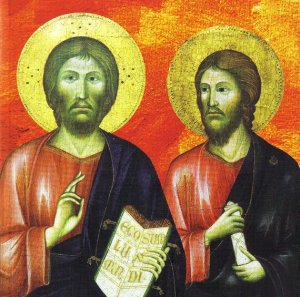
We’re starting this week a five weeks sermon series on the book of James. You may know that James, the author of this letter, is believed to be “the” James, the brother of Jesus. The picture on the cover of our bulletin today is actually an illustration of this tradition: It’s a portrait of James (in the back) listening to Jesus. We see that Jesus is opening the Scriptures, explaining the scriptures for people, and we see James listening carefully and holding on to his own scroll, as if preparing himself to write about what he has just heard.

I love this icon first of all because it shows the physical resemblance between Jesus and James, which would be the case if we believe they were both born of Mary (some theologians think James was Joseph’s son, from an earlier marriage). But at any rate, beyond the physical resemblance, I would like us to notice the resemblance between Jesus and James in their character. When you read James, you will be surprised to realize how his tone his different from, say, Paul who can be quite defensive and argumentative or even a bit paternalistic. The overall tone of the letter of James is very humble, gentle, it is written with a lot of simplicity, although James is also able to pronounce stern warnings against the rich and the double minded. In this, James is close to Jesus, who was always humble, made his teaching accessible, and who yet could be very bothered by hypocrites and people clinging to their privileges. As a side note, I love it too that James call the members of his congregation “brothers and sisters”. As their leader, James still feels like their equal – probably being Jesus’s sibling in the flesh had taught him how much God is not interested in false hierarchies.

Another resemblance between Jesus and James – and I guess the most important – another resemblance is their teaching. During this time when we will be reading from James, you will notice how accessible James’s teaching is, which does not mean it isn’t profound. Like Jesus, James uses simple words to talk to people, and he also talks a lot about everyday life – he does linger of the theory (another difference with Paul who spends a lot of time explaining theological concepts). For James, our faith is not so much a matter of belief, rather it is something we need to practice in our concrete circumstances and inside our community. To say it simply, James focuses on the way we live, and more specifically, as announced in the title of this sermons series, James focuses on the way we treat each other as the place where our faith is experienced – and often tested.

We are today in the first chapter of the letter, and this chapter could be read as an introduction on what’s to come. The main theme (or the main thread if you prefer) – and we have just heard that in our reading – is that throughout the letter, James is seeking to show what true religion is, “True religion” not as opposed to “No religion at all”, and not as opposed to “a religion with a false teaching”. What James does is that he opposes “True religion” to a religion that would be “shallow religion” – and this is where, the teaching, although very accessible, actually gets very deep!

And so as we start our study today, we will try to understand a little better what James means by “true religion”, how it manifests itself but also, of course, since James is always practical, how it is that we can get there.

First of all, what is true religion? Well, we often defines religion as a matter of belief with a list of articles of faith, or we define religion as a matter of belonging, to an institution or to a community, but to James religion is not so much a matter of belief (at least not in the sense of an adhesion to a set of theoretical ideas) and religion is not about membership. To James, true religion is “a matter of doing” and in “doing”, James does not mean practicing rites but being in a relationship with God by prayer and being in relationship with one another, by treating each other with respect and fairness and, when possible, with affection. For example, James says that true religion is to care for the “orphans and widows” (the poor, the least powerful) or he says that true religion is to “bridle our tongues” (and it’s not about avoiding profanities, it’s about not speaking evil of each other). True religion is all about love but you’ll notice, it’s not about having fuzzy feelings either. James tells us that true religion isn’t about “deceiving our hearts” which is also translated as “indulging our hearts”. True religion isn’t about convincing ourselves that we love everybody, true religion is about loving people in words and action.

To me, this makes this letter very relevant for today. We live in a society where there are a lot of tensions, we are divided, we get emotional and we forget to respect each other or we disrespect people willingly because they don’t think like us, act like us or don’t look like us. Christians communities are not exempt from being contaminated by these divisions, we even have to acknowledge that sometimes we even lead the way.

And so James asks us to take a good look at ourselves – which is actually the very example he uses – with the image in the mirror. James invites us to look at ourselves in the spiritual mirror. We profess to be Christians but how is it that we concretely act? How is it that we treat each other? It is easy to deceive ourselves by thinking that we welcome the poor, or that we have no racial bias for example, but if we look in the spiritual mirror, we will know if our religion is all in our head or if it is real. The spiritual mirror is our everyday life, in the concrete way we treat each other, it’s not who we profess to be or we think we are or what we believe about God. If we look at our actions or if we listen our own words, we will then know the truth about ourselves (and we’ll talk more about that next week because that’s actually an idea that James develops in Chapter 2 and further).

What we need to notice for now is that, for James, true religion is a religion that brings change in the people who practice this religion. The letter of James is actually often considered to be part of what we call “Wisdom writings”. James is inviting us to wisdom and to grow spiritually. Now what does it mean to grow spiritually? It does not mean to grow in number or in activities! Our idea of spiritual growth is often modeled on economical growth, but spiritual growth is about becoming mature Christians, it is about changing, reforming ourselves, becoming more self aware. We have to look into the mirror and discover who we are like and make the changes, so we can become a true image of the God who created us.

There is a comic strip I like. It’s a church meeting and the pastor is talking about how to make spiritual growth happen in the church. The pastor says “Well, if we want to grow spiritually, maybe we need to have more programs”, and then other people start raising their hands and say things like: “Maybe we need to have more people” or “maybe we need to bring in more money”. But then a young guy sitting in the back asks candidly: “If we want to grow spiritually, maybe we need to deal with our own issues and take responsibility for ourselves?”. Of course, the young guy ends up at the door, because the pastor does not like hearing that…Yet maybe the guy has a point, maybe he could even be a disciple of James! For James, spiritual growth is about transforming ourselves and nobody can do the work for us, not even institutionalized religion – James says we have to be doer of the word, and not just hearers – “Doing the work” meaning first working on ourselves. James is very practical indeed, his theology is simple but it’s certainly not easy! It actually can be quite disheartening to take a good look at ourselves and to try to reform ourselves. Who among us is indeed “quick to listen, slow to speak and slow to anger” as James says we need to be?

The good news is that James does not leave us there. Chapter 1 reminds us that we are to ask God for help because God is the giver of all good gifts. God is generous and will give us wisdom as we ask.

And that’s another thing I really like about James and that makes him very relevant for today. James does not do a lot of speculations on who God is or what God does. The only thing James says about God is that God is good and that God gives good gifts, God’s main gift being how God helps us to mature into the fullness of the people we are called to be. This wisdom God gives us isn’t for our own benefit only, so we become “smart people” or even “good people”, this wisdom – and we’ll talk more about that in the weeks to come – this wisdom is given so we may help and support each other through our trials and enjoy good relationships within our community. Not easy, but probably worth pursuing!

Proper 16 (B) – John 6: 56-69

Those who eat my flesh and drink my blood abide in me, and I in them. Just as the living Father sent me, and I live because of the Father, so whoever eats me will live because of me. This is the bread that came down from heaven, not like that which your ancestors ate, and they died. But the one who eats this bread will live for ever.”

This week, we hear again this passage from John Ch 6 that we heard last week. Last week, these words were the concluding words of our reading, this week, these are the opening words and then we get to the end of the Chapter. This isn’t, as you may have noticed, a happy ending. The words Jesus speaks are crude and difficult to hear, the crowd is shocked, a lot of disciples turn away. Peter remains and yet, it seems, almost halfheartedly: he does not like what Jesus says either but he and the eleven have nowhere else to go, and among the eleven, Judas is “a devil” who is going to betray Jesus by handing him over – which is, of course, an even worse thing to do than to just turn away – v70-71, that we’re missing in the lectionary, perhaps because they’re too dark.

This dark tone may be surprising since we have noticed in these past weeks that the feeding of the 5000 is this great miracle that is told in all four Gospels, and maybe one of the most famous miracles Jesus ever did. It should have made for a lot of Jesus’s popularity. Yet we noticed also that the way John tells us the story is different from the other evangelists. John adds this long section after the miracle where Jesus explains the spiritual dimension of the miracle, and we realize that people aren’t on board with this. They come for the physical bread, the good benefits they can obtain from Jesus, but they are not ready to accept who Jesus really is. To say the truth, they are disappointed. Jesus does not want to be their king after all, he is not really going to change life as they know it, although he very well could if only he would. Jesus is asking people for a spiritual transformation. He asks them to work for the bread that does not perish and to do the work God requires: to believe in the one God sent.

Now I said that we were going to talk about the Eucharist in this sermon series, and we could wonder how this relates at all to the Eucharist. Well, if you remember from last Sunday, we talked about Jesus’s presence in the Eucharist. We said than, less important than the rite itself, or the way we perform the rite, we come to the Eucharist to receive the presence of Jesus. The thing is, there is the flip side of the coin, and to me this is what this Gospel leads us to think about. To celebrate the Eucharist, we have to be present too. What is the sacrament worth if Jesus is willing to give himself, but we are unable to show up for him?

We noticed last week that there is much more to be present than sharing the same space. Being present is intentional. We have the means to connect with people on the other side of the world. We may not be present physically in the same room, yet our love or affection is still the same and still as valuable when we meet on line. The thing is: the opposite is possible too. We may very well be in the same room, and yet lack this deep connection. I don’t know about you but often when I read the Gospels, I think how lucky were all these people to be able to meet Jesus “in person”, things should have been so much easier for them! And yet we see that it wasn’t. In this Chapter of John, the crowd and the disciples have just received the bread from Jesus himself (and not from some random minister!) and yet they fail, they fail as much as we do, to understand Jesus, to receive Jesus, to follow Jesus – to be in communion with Jesus – and they also fail to be in communion with one another: They stick together because they have no better option and Judas is going to betray not only Jesus but all of them as a group.

And so indeed those words are hard to hear: We can celebrate the Eucharist, we can be right there in this spot with Jesus, and yet fail to be in communion with God and with one another. I told you last week that the Eucharist isn’t magic, so I guess this is where we are: Contrarily to what we might think, it is not enough to have God’s presence if we are not able to bring to God our own presence, which is just not our physical bodies. We can share the same room, meal or bed with the one we love, if we are not there with them with our hearts and minds, then the rest does not matter. There will be no communion.

So after we have talked about how Jesus was present for us in communion, it could be a good idea for us this week to be thinking about the way we want to be present to Jesus in communion.

The first thing we have to do to be present is to bring our intention, our desire of being present. This is at least what our liturgy invites us to do when we say the Collect for Purity at the beginning of our service: Almighty God, to you all hearts are open, all desires known, and to you no secrets are hid: Cleanse the thoughts of our hearts by the inspiration of your Holy Spirit, that we may perfectly love you and worthily magnify your holy name, through Christ our Lord”.

We start our celebration of the Eucharist by telling God our desire to be with God and how worthy God is to be worshiped (Gloria and Collect of the Day). We acknowledge the things that are on our minds and keep us away from God to recenter on our intention of being here. In the same way that it is sometimes hard to be with our family because there is so much going on at work, or sometimes it is so hard to work because there is so much going on with our family, we have to refocus to be truly present.

Then to be present, we have to listen, to be attentive and open enough to be curious about the ones we are with – open to what they have to tell us. And that’s the second way we have to be present in the Eucharist too: listening to get to know God better and to hear what God has to say to us as a church but also as individuals. This is why we listen to the Scriptures (four readings!) – the word of God spoken to us in Ancient times – and the sermon – which ideally would explain how these ancient words are relevant for us today.

Finally, and this is the last part of our worship before we celebrate the Eucharist, to be fully present we have to be repentant. Aware of our limitations we pray for what we need and we also pray for the forgiveness of our sins. It is not about condemning ourselves, but presence, “real presence”, requires self awareness, we’re called to be authentic, not “holding back” – present with our true selves, not the selves we wish we had. This was probably the stumbling block for most people at Jesus’s times – and it is probably the same for us today. People weren’t willing to continue to follow Jesus because they hoped Jesus would fulfill their own agendas, instead of being able to follow Jesus and serve him. In the same way, we often come to God desiring to receive, to be filled, but we are not that willing to change, to be transformed and to receive “Eternal life” – which is not only everlasting life but this very life that comes from God. Godly life, holy life.

In John’s, Jesus presents himself as the Sacrament, his flesh and his blood are the presence of God. There is very possibly this idea in John that, as we drink the wine and share the bread, we are also called to be the Sacrament. To embody Christ for one another in our church, family and in our own communities, each one of us and as a church. We use to think that we come to church to receive communion, but maybe it would be more accurate to say that we come to church to be in communion, with God and with one another. This is what we manifest when we celebrate the Eucharist, as we do so, we become Jesus’s flesh and blood, we become the Sacrament.

Now concretely: How is it that we can be in communion? This is the theme that we are going to study in our next Sermon Series, leaving “mystical John” for the very “down to earth James”. During five weeks starting next week, we will be reading from the Letter of James and James shows us how being Christian is all about the way we treat each other, all about learning how to live with one another – and not just worship. Worship is the manifestation of a communion that takes place in the hearts.

Proper 15 (B) – John 6: 51-58

Those who eat my flesh and drink my blood abide in me, and I in them. Just as the living Father sent me, and I live because of the Father, so whoever eats me will live because of me. This is the bread that came down from heaven, not like that which your ancestors ate, and they died. But the one who eats this bread will live for ever.”

We will hear those very verses next week again. Jesus inviting us to “eat his flesh’” and “drink his blood”. This is a rather crude way to put it, and yet these are also the very words the priest pronounces each time the Eucharist is celebrated – when we recall Jesus’s last supper with his disciples with the blessing and sharing of the bread and the wine.

I said earlier I wanted to use the long reading from John we have this season as an opportunity to consecrate time to talk a bit more about what we do when we celebrate the Eucharist – and also to think a bit more about the challenges of celebrating the Eucharist in a time of pandemic and the different questions it has raised in our minds. Of course, as you probably know, there have been two thousands year of conversations and also controversies on the Eucharist, so I would like to be clear that, first of all, my intention is not to cover all that have been said about the subject, even in our own Episcopalian tradition (For example, you may know that the Holy Eucharist has started to be the main service in our church only about 30 years ago, it used to be Morning Prayer). I would also like to be clear on the fact that the teaching I would like to share with you today is mainline Protestant theology and is still a topic in debate. I like to think that I have been formed by many readings, conversations and reflections, yet this teaching is offered from my own limited understanding – an understanding that you are surely invited to analyze for yourself and discuss respectfully with one another and with me. My main references for this sermons series are the books “A guide to The Sacraments” by John Macquarrie and “Sacraments and Sacramentality” by Bernard Cook – both of them being used for the training of clergy and laity as main references in Episcopalian seminaries.

This said, for today, back to our Gospel first and I would like to point out to you how interesting it is that in John’s Gospel, there is no mention of Jesus’s last supper with his disciples – oh, actually there is, when Jesus washes his discipleship’s feet – but there is no mention that Jesus blessed the bread and the wine and asked his disciples to do the same in memory of him. The story is told in Matthew, Mark and Luke, but for most scholars this is this very chapter (Chapter 6) that “replaces” the account of Jesus’s last meal in John’s Gospel. Chapter 6 in John’s is very likely, in Jesus’s mouth, John’s theology on the Eucharist, the way John and John’s community understood what happened when they blessed and shared the bread and wine.

And so to me, this is very important to notice that in the Gospel there is sort of an “interchangeability” between Jesus’s acts and Jesus’s words in regard of the Eucharist, and it is especially important to notice that in a time of pandemic, or whenever we are not able to receive the sacrament (because of disease, travel, lack of an ordained minister and so on). It is also important to notice these things when we are not able to receive the sacrament in full or the way we used to (which is our case these days, receiving the bread only and not the wine). We see here in Chapter 6 that John does not focus so much on the way we celebrate, or on the concrete signs of the celebration, but John focuses on the mystical, or if you prefer, on the spiritual meaning of the Eucharist as a participation in the life of Christ. Theologians define a sacrament as “a visible sign of an invisible grace”. They say that, for example, the water of baptism is a sign of the forgiveness of sins – it is also, more deeply, a sign of the passage (through the water) from death to life (as the Hebrews crossed the red sea from the land of slavery to the promise land). Sacraments are a sign of moving from a place of death (separation from God) to a place of life (union with God through Christ) and to make it concrete, or rather to manifest this reality of grace and salvation, we use signs, yet what really matters, and this is what John reminds us of, is the meaning we put with the sign, not so much the sign in itself.

During this time of pandemic, when we have to worship on line, we have been talking about “spiritual communion” – we say we do “spiritual communion” when we say the prayer but don’t receive the bread and the wine. Well, I don’t really like this term of “spiritual communion” because of course communion is always spiritual, even when we do receive the bread and wine – if it isn’t a spiritual act for us, then it has very little value, it isn’t the small amount of bread we eat, or the small amount of wine we drink that is going to satisfy us. Now those signs are important, but they are important not so much in themselves, rather they are important because of the meaning they carry, the intention that comes with them – we do not just share the bread and wine, we pray over them to manifest our intentions and God’s intentions through Christ’s promises. It is important to manifest our faith in concrete ways, in the same manner that we would manifest our love in a concrete way. When we offer flowers to someone we love, our love isn’t in the flowers themselves and yet our flowers carry the affection we have for that person, and it matters to them that we offer this sign of our affection. . In the same way, when we have the occasion, it is very wonderful to be able to celebrate the Eucharist with bread and wine that can be eaten and drunk, but it is not magical either, the bread and the wine do not contain the grace in itself as surely as a bouquet does not contain our love in itself. Communion with God through Christ is spiritual, and also manifested in concrete signs, sacraments. The bouquet is a way of manifesting love, of making this love present and actual, for the person to whom it is offered. In the same manner, when we celebrate the Eucharist, we ask God to pour God’s spirit on the bread and the wine, so these elements may be, to us, the body and blood of Christ, so they may make Christ present unto us through the bread and the wine.

Bread and the wine are not a mere symbol, of course. Jesus’s insistence on “eating his flesh” and “drinking his blood” reminds us that our faith is embodied, Jesus didn’t just give us teachings and instructions or a moral way of life but gave his body and his blood for us. In the same way, we are to respond to his love with our whole being – it’s not something that just happens in our heads – and that’s why we gather to receive the Eucharist. Spirituality encompasses our whole being, body, heart and mind. Jesus gave himself for us and we have to give ourselves to him, not just send our good thoughts or good intentions! We also have to live out our unity with Christ in our flesh and blood, in our daily life, way beyond what happens at church only. The Eucharist we celebrate at church is a sign that our faith is concrete and requires a commitment of all our being.

Now what happens when we worship on line? I don’t think it annihilates the way Christ becomes present to us. There are many ways of being present, and we all had a lot of opportunities to experience that in the past 18 months. Even when we could not gather in person, calling friends and family has been our way of being with them. Of course, we much prefer meeting in person, but there is no lesser love or value in our affection when we meet this way – it possible that meeting on line only will affect the relationship in the long term because of course meeting on line does not allow us to have the same level of experience than when we meet in person, but when it’s our intention to spend time and relate to people we love, we know that it’s still very valuable to meet on line. I think it is the same with church. When we have the intention to be united with Christ, Christ will come to us. The sacrament isn’t magical, Jesus isn’t “contained” in the host itself. The sacrament of the Eucharist is the vessel in which Jesus comes to us at church, it is a wonderful thing to be able to do the rite in full as we did before the pandemic, but certainly our relationship with Christ does not depend on our ability to perform the rite. Communion is beyond the rite. The rite makes manifest a spiritual communion. John does not describe how the sacrament in supposed to happen for his community, but he wants them to understand what’s going on when they share the bread: They manifest their longing to be wholly united to Christ, and also to one another. If we are all united to Christ, we are also all united to one another.

To me, that’s another aspect of this pandemic: When there is a contagious disease, we are forced to realize that our flesh and blood, our bodies aren’t only our own body and so we can do whatever we want to do with them. Our own body depends on other people’s bodies and the way they treat them, or the way they are affected. Having different bodies, we are united in sharing in the same human flesh. In the same way, there is a deep and invisible unity for Christians that goes beyond what meets the eye. It is nice, enjoyable to be with one another in the same space, but if there is much more to our being together, a deeper unity in the flesh of Christ and we’ll talk more about that next week.

I don’t know if you remember from before I left for vacations, I told you that the feeding of the 5000, and moreover the discourse that follows, are a “test” for Jesus’s disciples – a test not being a pop quiz, a trial or a punishment, but an opportunity to go from one level of faith to another. To me, this is what this pandemic could be to us, an opportunity to go from one level of faith to another, to go, with John’s, beyond the visible, the tangible, what we can see but also touch or eat, to experience a deeper and broader presence of Christ. It could actually be for us one very meaningful thing we could do in a time where there are so many things that we cannot do the way we used to.

Proper 12 (B) – John 6: 1-21

– We are back today in John’s Gospel – actually in the chapter 6 of John’s Gospel and we are going to spend the next four weeks reading from it. I was almost tempted to read the whole thing today, but it’s almost a ten minutes read, so I hope you get a chance to read it at home, it would be really helpful to have the whole thing in mind as you hear those different passages in the coming Sundays.

Interestingly, although we aren’t reading from Mark’s Gospel anymore, we pick up exactly where we left off. If you remember from last week, I told you that in our lectionary we had two short extracts of Mark that left aside what was in the middle – the feeding of the 5000 and Jesus walking on the water. Well, this week, the lectionary comes back to those stories, but we will hear them from John’s point of view.

So why do we have such a thing? Well, as you may remember from our previous study, John is the most developed Gospel of all – it does not only tell stories, it explains stories. And this is certainly very true of this very Chapter. Jesus feeds the 5000, and then the rest of the chapter is dedicated to explain the miracle. In fact, we don’t have “miracles” per se in John’s Gospel. John calls them “signs”, for this very reason that the wonderful deeds Jesus perform are not performed for the show (that’s also true in all the Gospels), moreover, the signs aren’t only an expression of Jesus’s care and compassion – the signs Jesus performs in John’s Gospel have a spiritual significance, and each time John speaks about a “sign”, we will have a long discourse after the sign so we can understand, so we can believe, what’s it’s all about – and that is exactly what happens in this Chapter. Jesus gives the bread to all people to make understand that he himself is the true bread that comes down from heaven.

Our lectionary invites us to spend five weeks on this because, of course, we are a liturgical church, we receive every week the body of Christ – so we want to think deeply about what it means. And it’s especially interesting that we think about it now because this time of pandemic, and the changes in our worship that have occurred because of that, have certainly raised concerns in our minds as we have had to think differently about the way we celebrate communion: receiving “spiritually” rather than “sacramentally”, receiving only the bread, not the wine and so on…We’ll spend more time on that the two last weeks of August, when I would like to really dedicate time the meaning of communion.

For now, we have the story, the “facts”, what happened on that day by the Sea of Tiberias, we’ll come later with John to the spiritual significance. Yet if we want to understand the meaning, we have to be attentive to the story, and so today I would like to point out a few things we really need to notice:

– First thing we need to notice is that the feeding of the 5000 has been reported in all four Gospels, and each time it’s at the center of the Gospel – which gives us a cue that it is a very important passage. Yet John, tells it in a very unique way if we pay attention to the details.

First of all, John places the story close to the feast of the Passover, which is of course this time where the Jews remembered their liberation from Egypt and how they had been fed by the manna sent by God in the wilderness. So we know the story here is not only about material bread.

Then, in John’s story, Jesus takes the initiative of the miracle. If you remember from Mark’s Gospel, each time Jesus does a miracle is when people beg him, fall at his feet. In this case, Jesus asks a question to Philip about how to find bread for the people, when nobody has asked Jesus for food. Besides, in other accounts of the story, people have spent three days listening to Jesus in the wilderness – they would have been really hungry – here people are surrounded by villages and everything happen in the same day, they certainly must have been hungry, yet they were “regular hungry” if you will, not starving, and they would have been able to find food on their way back. They didn’t need a miracle.

So what’s important to notice is that John shows us that Jesus does not act out of compassion in this account of the 5000. It does not mean that Jesus wasn’t compassionate of course, but here it wasn’t his main motive for action.

– So then our question should be, like in a proper investigation: “What was the motive?” Well, we don’t have to look for an answer for very long, we have it in verse 6 of our passage: Jesus asks in order to test Philip, and actually, all the other disciples. And of course, when he does so, he tests us as well, so I would like us to think a bit about that today.

First we have to understand what is a “test”. I guess, for most of us, when we say that a problem, a trial or a temptation in our lives is a “test”, we understand “test” as a student in school, kind of a “pass or fail” thing. We imagine that God wants to see if we are good or bad students, good or bad disciples, good or bad people. Will we overcome the difficulty, or will we be overcome by it? Well, it’s surprising that this kind of thinking is so well spread among Christians because it isn’t what the Scriptures are about. When God “tests” or Jesus “tests”, there is no ready made answer we have to find out, a correct one among all the wrong ones. Rather, tests of faith are opportunities to deepen our relationship with God, to grow and to mature spiritually: There comes a problem, a trial or a temptation in our lives and the level of faith we have seems to not be enough to cope with what’s going on, we have to come closer to God.

In this case, we see that Philip is quickly overcome by the difficulty. A problem shows up – We need to feed all those people says Jesus – Well, there is not enough money to do that replies Philip, so you know, “thanks for bringing that up” but basically there is no way to fix the problem. I guess Philip is a realist, which is not always bad, but from our point of view, we realize he still does not get it. Jesus had turned the water into wine at Cana – and this, Andrew seems to remember. Andrew turns to the boy who can only provides five loaves of barley (the cheapest ones) and two fish. Not very realistic, as he himself notices, but it’s at least something and that gives Jesus a place to start. Instead of renouncing because they don’t have enough, they give what they have and they trust Jesus to take over.

Instead of renouncing because they don’t have enough, they give what they have and they trust Jesus to take over. Well, I think this is very true for all of us. Certainly they are times we feel overwhelmed by a problem or a difficulty, in our personal lives,in the life of our church, when we see what’s going on in the world…

Yet each time, Jesus still ask us if we are:
– willing to help
– willing to share what we have, as individuals but mostly as a community
– willing to give even if we have very little (he does not ask us to give what we don’t have)
– and if we trust him to do something with it.

It may be financial or material resources, it can also be intellectual or spiritual resources, it can be about giving a little bit of our hearts or a little bit of ourselves. He won’t do it without us, but he will use whatever we give him when we give generously. Yet are we willing to help, or are we waiting for God to fix our problems and other people’s problems? Our desire to help is our prayer and our offertory.

So I said that this story is about the Eucharist, right? We have stopped bringing offertory to the altar during this time of pandemic, but it is exactly to this part of the story that it relates: As the young boy, as Andrew, we bring the little we have: the bread, the wine, our money offering, and we expect God to transform them through Jesus. And of course, bread, wine, donations are only what’s visible. The offertory is this time when we are asked to offer ourselves to God in prayer, so God can use us in the same way Jesus used the bread to feed the people. Jesus gives thanks, bless what has been given, and then there is enough for everybody.

So, this is the test: Will we seek for enough faith to be willing to help? Will we seek for enough faith to give the little we have? Will we seek for enough faith to trust God to take over, or, as one theologian puts it: Do we believe that God is big enough for ours problems?