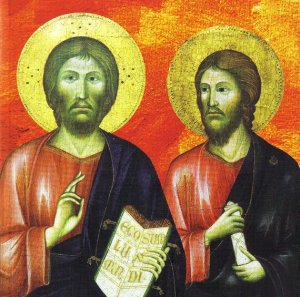
We’re starting this week a five weeks sermon series on the book of James. You may know that James, the author of this letter, is believed to be “the” James, the brother of Jesus. The picture on the cover of our bulletin today is actually an illustration of this tradition: It’s a portrait of James (in the back) listening to Jesus. We see that Jesus is opening the Scriptures, explaining the scriptures for people, and we see James listening carefully and holding on to his own scroll, as if preparing himself to write about what he has just heard.
I love this icon first of all because it shows the physical resemblance between Jesus and James, which would be the case if we believe they were both born of Mary (some theologians think James was Joseph’s son, from an earlier marriage). But at any rate, beyond the physical resemblance, I would like us to notice the resemblance between Jesus and James in their character. When you read James, you will be surprised to realize how his tone his different from, say, Paul who can be quite defensive and argumentative or even a bit paternalistic. The overall tone of the letter of James is very humble, gentle, it is written with a lot of simplicity, although James is also able to pronounce stern warnings against the rich and the double minded. In this, James is close to Jesus, who was always humble, made his teaching accessible, and who yet could be very bothered by hypocrites and people clinging to their privileges. As a side note, I love it too that James call the members of his congregation “brothers and sisters”. As their leader, James still feels like their equal – probably being Jesus’s sibling in the flesh had taught him how much God is not interested in false hierarchies.
Another resemblance between Jesus and James – and I guess the most important – another resemblance is their teaching. During this time when we will be reading from James, you will notice how accessible James’s teaching is, which does not mean it isn’t profound. Like Jesus, James uses simple words to talk to people, and he also talks a lot about everyday life – he does linger of the theory (another difference with Paul who spends a lot of time explaining theological concepts). For James, our faith is not so much a matter of belief, rather it is something we need to practice in our concrete circumstances and inside our community. To say it simply, James focuses on the way we live, and more specifically, as announced in the title of this sermons series, James focuses on the way we treat each other as the place where our faith is experienced – and often tested.
We are today in the first chapter of the letter, and this chapter could be read as an introduction on what’s to come. The main theme (or the main thread if you prefer) – and we have just heard that in our reading – is that throughout the letter, James is seeking to show what true religion is, “True religion” not as opposed to “No religion at all”, and not as opposed to “a religion with a false teaching”. What James does is that he opposes “True religion” to a religion that would be “shallow religion” – and this is where, the teaching, although very accessible, actually gets very deep!
And so as we start our study today, we will try to understand a little better what James means by “true religion”, how it manifests itself but also, of course, since James is always practical, how it is that we can get there.
First of all, what is true religion? Well, we often defines religion as a matter of belief with a list of articles of faith, or we define religion as a matter of belonging, to an institution or to a community, but to James religion is not so much a matter of belief (at least not in the sense of an adhesion to a set of theoretical ideas) and religion is not about membership. To James, true religion is “a matter of doing” and in “doing”, James does not mean practicing rites but being in a relationship with God by prayer and being in relationship with one another, by treating each other with respect and fairness and, when possible, with affection. For example, James says that true religion is to care for the “orphans and widows” (the poor, the least powerful) or he says that true religion is to “bridle our tongues” (and it’s not about avoiding profanities, it’s about not speaking evil of each other). True religion is all about love but you’ll notice, it’s not about having fuzzy feelings either. James tells us that true religion isn’t about “deceiving our hearts” which is also translated as “indulging our hearts”. True religion isn’t about convincing ourselves that we love everybody, true religion is about loving people in words and action.
To me, this makes this letter very relevant for today. We live in a society where there are a lot of tensions, we are divided, we get emotional and we forget to respect each other or we disrespect people willingly because they don’t think like us, act like us or don’t look like us. Christians communities are not exempt from being contaminated by these divisions, we even have to acknowledge that sometimes we even lead the way.
And so James asks us to take a good look at ourselves – which is actually the very example he uses – with the image in the mirror. James invites us to look at ourselves in the spiritual mirror. We profess to be Christians but how is it that we concretely act? How is it that we treat each other? It is easy to deceive ourselves by thinking that we welcome the poor, or that we have no racial bias for example, but if we look in the spiritual mirror, we will know if our religion is all in our head or if it is real. The spiritual mirror is our everyday life, in the concrete way we treat each other, it’s not who we profess to be or we think we are or what we believe about God. If we look at our actions or if we listen our own words, we will then know the truth about ourselves (and we’ll talk more about that next week because that’s actually an idea that James develops in Chapter 2 and further).
What we need to notice for now is that, for James, true religion is a religion that brings change in the people who practice this religion. The letter of James is actually often considered to be part of what we call “Wisdom writings”. James is inviting us to wisdom and to grow spiritually. Now what does it mean to grow spiritually? It does not mean to grow in number or in activities! Our idea of spiritual growth is often modeled on economical growth, but spiritual growth is about becoming mature Christians, it is about changing, reforming ourselves, becoming more self aware. We have to look into the mirror and discover who we are like and make the changes, so we can become a true image of the God who created us.
There is a comic strip I like. It’s a church meeting and the pastor is talking about how to make spiritual growth happen in the church. The pastor says “Well, if we want to grow spiritually, maybe we need to have more programs”, and then other people start raising their hands and say things like: “Maybe we need to have more people” or “maybe we need to bring in more money”. But then a young guy sitting in the back asks candidly: “If we want to grow spiritually, maybe we need to deal with our own issues and take responsibility for ourselves?”. Of course, the young guy ends up at the door, because the pastor does not like hearing that…Yet maybe the guy has a point, maybe he could even be a disciple of James! For James, spiritual growth is about transforming ourselves and nobody can do the work for us, not even institutionalized religion – James says we have to be doer of the word, and not just hearers – “Doing the work” meaning first working on ourselves. James is very practical indeed, his theology is simple but it’s certainly not easy! It actually can be quite disheartening to take a good look at ourselves and to try to reform ourselves. Who among us is indeed “quick to listen, slow to speak and slow to anger” as James says we need to be?
The good news is that James does not leave us there. Chapter 1 reminds us that we are to ask God for help because God is the giver of all good gifts. God is generous and will give us wisdom as we ask.
And that’s another thing I really like about James and that makes him very relevant for today. James does not do a lot of speculations on who God is or what God does. The only thing James says about God is that God is good and that God gives good gifts, God’s main gift being how God helps us to mature into the fullness of the people we are called to be. This wisdom God gives us isn’t for our own benefit only, so we become “smart people” or even “good people”, this wisdom – and we’ll talk more about that in the weeks to come – this wisdom is given so we may help and support each other through our trials and enjoy good relationships within our community. Not easy, but probably worth pursuing!